May 18th, 2006

Paul Harvey Knew What We Wanted

I watched Serenity again tonight (my 153rd movie for the year and my fourth time total seeing it, for those keeping track), and it struck me why I like it so much: it finishes the story Firefly began. I like the characters and the world they inhabit, but knowing what the deal was is even bigger for me.

For the two of you who don’t know: Firefly was a television series that Fox canceled too quickly. The complete series was put out on DVD, which is where I learned about it, watched it, and loved it. Last year the movie Serenity, a movie based on the show, was released. It didn’t do very well in theaters and it’s probably the last we’ll see of the Firefly universe.

The series had an overarching storyline about a girl named River Tam with a mysterious past. Hints and pieces of the puzzle were given in the series, but they were little more than “the Alliance did things to her brain and now she’s just not quite right” sorts of things. The movie, though, answered the questions and put a period at the end of the sentence. Sure, there were some loose ends (Shepherd Book? What about him?!?), and there are certainly more stories that could be told, but the main mystery was answered. Done. Finished. End of story.

I can’t understand how writers can do this kind of thing. It’s hard enough telling a story, but telling a story over several episodes, only giving hints here and there – man, I couldn’t do it. The X-Files did it for nine seasons. Lost has been at it for two. If I hadn’t fallen into The X-Files a couple seasons in, I don’t think I would have had the patience to watch it until the end. I don’t watch Lost and you can’t make me.

I need to know the whole story. I want to know why the things that happened happened. Smallville’s okay for me, because even though I might not know what’s going to happen in the current “what’s going on?!?” storyline, I know that Clark ends up being Superman and Lex ends up being his worst enemy.

Oh, uh, spoiler alert, I guess. I hope I didn’t ruin the upcoming Superman Returns for you.

I don’t think I’m alone in my desire to know the full story. Why do people read newspapers and news websites and watch “Behind the Scenes” specials? There’s a special feeling you get when you know something someone else doesn’t. I can spend hours reading the trivia on IMDB. I find those little details so very interesting.

I think “desire to know” is what spawns conspiracy theories. There’s got to be more than just one guy shooting JFK. There have to be UFOs. The government can barely handle getting laws passed, but they have to be hiding all sorts of secret agendas from us.

All of this “knowledge,” though… how much of it is worthwhile? I think maybe we’ve been sold a counterfeit product. Instead of seeking wisdom, we look for knowledge and facts.

Alexander Pope said, “People who know only a little do not understand how little they know and are therefore prone to error.” Or, put plainly, “a little learning is a dangerous thing.” And in the grand scheme of things – life, love, happiness, pain – doesn’t any amount of learning end up being “a little”?

I think that’s why it’s so satisfying to know the end of a thing, to know the full story: it gives us a little foothold on the huge cliff of “Everything,” something we can deal with.

Sometimes that’s all we need to get us through a rough patch.
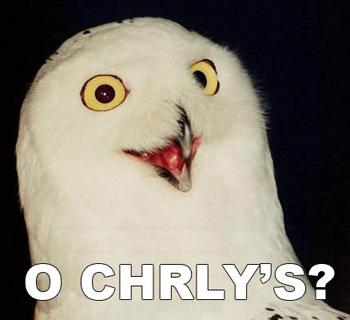
May 12th, 2006

Where Should We Go To Lunch?

O'Charley's O RLY? Owl

For reference: O’Charley’s
Also for reference: O RLY? owl

May 11th, 2006

AABBAAC

I entered the Poetry competition in the Academic Regionals my Junior year of high school. The whole trip and competition was a surreal experience that I’ll try to detail more when I get to that entry in my school memories series.

The way it worked was all the entrants would gather in one room with paper and pencils, and at the appointed time the proctor would announce the topic and start the clock. We’d have an hour to write a poem and then it’d get judged and announced later in the day. Our topic that year was “rain,” a perfect topic for a poem-writing angsty teenager, yes? I ended up writing a parallel sort of thing, with the first section being about nice, peaceful, refreshing rain and the second section being all stormy and violent. I was pretty happy with it at the time, though I’d be loathe to reproduce it here these days, I’m sure.

I’d never tried anything like this before – writing on a specific topic in a specific time frame. I’ve since learned that I work best with specific guidelines and specific deadlines, but at the time it was a new thing.

My friend Dave was in the same competition, only in the Senior category. When we were finished and were outside discussing the whole thing, he mentioned that when he turned in his poem, he happened to catch a glimpse of someone else’s poem in the stack. To this day I can still remember the bit he quoted. In fact, I sometimes just say it because the rhythm of it amuses me so:

I hear the pitter and the patter
As I sit beneath the tree.

Say that out loud in the sing-song way that most students read poetry in class and it might tickle your funny bone the same way it did ours. If it doesn’t, well, I guess that’s okay. It will never cease to amuse me.

It wasn’t that we were such fantastic poets, I don’t think. It was more of a recognition that it followed fairly basic poetic “rules.” The rigid meter was a dead giveaway that rigid rhyme schemes would follow. Dave and I wrote poems recreationally a lot, and he tended to be free-form and non-rhyming, while I was more about trying to be creative in the stricture of specific guidelines. Even so, I found the da-DA-da-DA-da-DA-da-DA-da meter amusing. It might be why I eventually strayed from it later on, though another big part of it was the poem I did in the competition my Senior year. Oog. It was every bit as laughable. Bad, bad, bad.

I went through the typical teenage phase of writing poems and “songs” and trying to get my feelings on paper in some way that people could understand mostly, but not fully. I tried to be deep and true and all of that. Man, I was going to be a writer.

I read some of that stuff every so often and I can’t help but shake my head. The sure-he-knew-everything youthful version of me never made it to my 34th birthday. I read what he wrote and remember why he wrote it, and I wish I could go back and tell him some things and try to get him to understand, even though I know he wouldn’t. Oh, he thought he did, of course, but one stage of life doesn’t understand the next, no matter how much it tries and prepares.

I read poetry sometimes, but it’s difficult for me. I know the poems mean more than they appear to mean, and since I don’t know what they’re trying to mean, I get frustrated. I can read a Robert Frost poem and immediately understand

Yet knowing how way leads to way,
I doubted if I should ever come back.

But when William Carlos Williams writes

so much depends
upon

a red wheel
barrow

glazed with rain
water

beside the white
chickens.

I wonder if I’m stupid for not getting it or if he’s the crazy one for writing it.

I like my allegories and allusions like I like my stop signs: evident and effective. Kenneth Koch hits at the very level of my frustration when he writes

In a poem, one line
May hide another line,
As at a crossing,
One train may
Hide another train.

It makes me feel ignorant. If I can’t visualize abstract ideas and am left with only concrete, what does that say about me? An imagination, an understanding of concepts and ideas – these are important to me.

Ultimately it was a Beatles song that helped me understand another concept. Rather, it was Dave’s explanation of a Beatles song that helped me. I complained to him that songs like “Come Together” make no sense to me. They weren’t telling any sort of story and the collection of phrases didn’t seem to have anything to do with each other. I don’t remember his exact words, but the gist of his explanation was that sometimes words paint pictures inexactly and it’s more about the sound of the words used. It doesn’t seem like much, but that explanation has helped me appreciate many a poem and song since then.

These days, I’m more inclined to latch onto a line here or there from a poem or song – what it says, how it says it, something just grabs me every so often. It’s usually something I can understand right off the bat, which still bothers me some times, but I don’t know how to work on that particular understanding “muscle,” so I do what I can.

To my surprise, I came in second in the poetry competition that year. The judges returned my poem to me with comments all over it, and it was the first time I’d had major attention paid to something I’d written. One of the judges really liked my “English spelling” in a phrase I’d used: “Spectre of Death.” I always wished I could have talked to her about her comments, but it never happened.

I don’t write poetry much any more. In fact, I can’t remember the last time I did. The closest I get these days is rewriting lyrics to songs, but that hardly counts. I just don’t seem to have the … heart or will or strong enough feelings or something. Poetry needs to come from somewhere deep and I feel so shallow these days that it’s not surprising.

I leave you with the following lines which caught my eye during this last National Poetry Month (April). The media specialist at school had put up a poster that had snippets and lines from a bunch of different poets, and one line struck me. It’s from Robert Penn Warren, and I think I like it because it says what it means:

You think I am speaking in riddles, but
I am not, for the world means only itself.